
Notes on Writing a Picture Book About Courage
Every story starts somewhere small. This one started with a kid under a kitchen table.
I didn't know his name yet, or what the weather was doing outside. I just had the picture: knees pulled up, eyes squeezed shut, a checked tablecloth hanging down like a tent. Then came the question every picture book has to answer sooner or later: what would it take to get him to come out?
Here are a few notes from the making of The Umbrella Named Captain Blue (working title), the rainy-day story video that's now on YouTube. If you're curious how a picture book about courage changes on its way from first idea to finished story, this is the honest version.
Why an umbrella
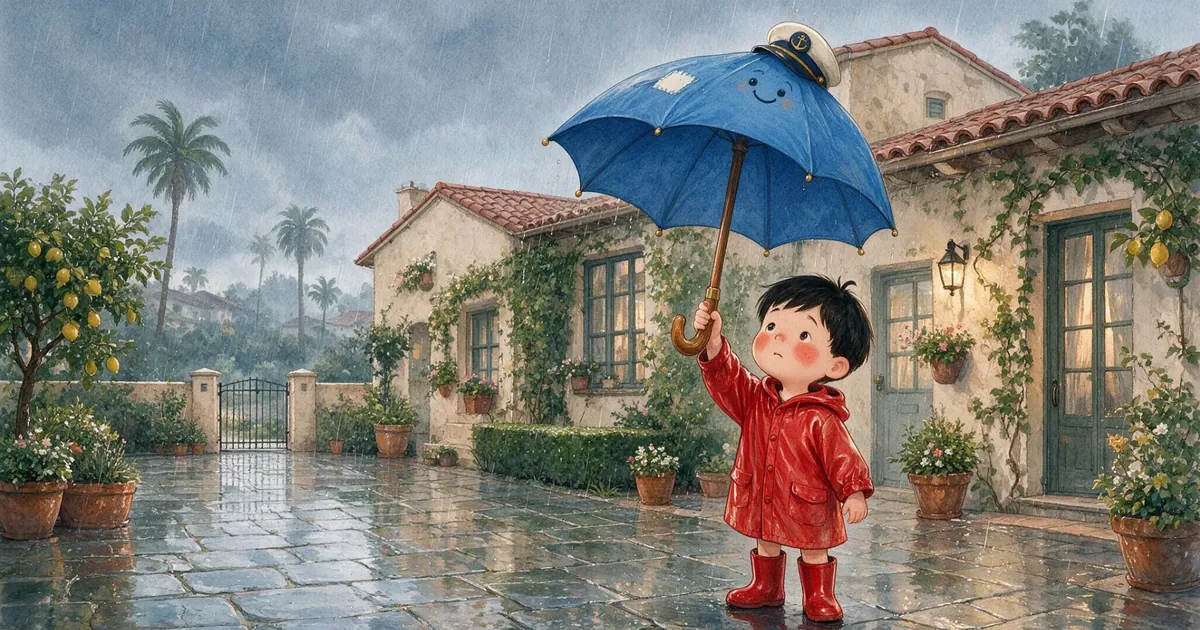
Scared kids don't usually need a speech. They need something to hold. An umbrella felt right for Benny because it already does two jobs: it's a shield, and, if the wind catches it just so, it's a sail. Once it had a name, it had a personality. And once it had a personality, Benny wasn't walking out into the rain alone.
It also mattered that it's an old umbrella. A little faded, a patch on one panel, a handle worn smooth. Brand-new things don't have stories in them yet.
What changed along the way
The first outline had a few moments that didn't survive. They were fine on paper and wrong for the kids who'd be listening.
The thunder moved indoors. In an early version, the loudest boom came while Benny was outside. But no story of mine should make walking into a storm look like the brave choice. So now Benny and Dad wait under the table until the thunder rumbles off, and the scare outside is a false alarm: a passing trash truck. Benny still freezes, and his heart still drums. It's just a safer kind of scary, and honestly a funnier one.
Benny steps back from the kitten. Originally, Benny held the umbrella right over a frightened kitten. Kind, but a real kid shouldn't get that close to an animal they don't know. In the story now, Dad says, "Let's not touch her. She doesn't know us." Benny still finds a way to help, from a safe distance, and it ended up being the bravest thing he does. I'll let the video show you how.
The ending lost its explanation. The first draft ended with a sentence telling you what bravery means. It was a nice sentence. It went. Kids can tell when a story is about to teach them something, and they deserve the chance to figure it out themselves. The story now ends on a picture instead of a lesson.
The sound of rain
Because this is a read-aloud, a lot of the writing was really about sound. Boom, rumble, mumble. Pitter-pat. Splish, splash, sploosh. Fwump. Those words are fun to say and fun to hear, and they turn the storm into something a kid can play with instead of just survive.
The setting is a courtyard apartment building, the kind you find all over Southern California: terracotta pots, a dripping lemon tree, stucco walls, a gate onto the street. Rain is rare enough around here that a rainy day feels like an event. Every gutter suddenly has something to say.
The watercolor-style illustrations in the video (AI-generated, like its narration) lean into that: gray light outside, warm lamplight in the kitchen, and puddles big enough to be oceans if you're six.
What brave looks like at six
The idea I kept coming back to is that Benny never stops being scared. His tummy drums the whole way across the courtyard. He goes anyway. That felt more honest than a kid who suddenly isn't afraid anymore, and more useful for the kids who are listening, many of whom have tummies that drum too.
If you'd like to bring the story into a rainy afternoon at home or in class, the companion guide has conversation questions and a simple activity, and this week's post on how to help a child who's scared of thunder has gentle, practical ideas for grown-ups.
You can watch the story here:
https://www.youtube.com/watch?v=a_zlAMSLT0s
More read-aloud videos are coming to the playlist. Follow along there, or here on the blog, for the next one.
— Ronald
Ronald Moy writes little stories about big feelings and everyday wonder for kids 4–8. His picture books are in development.